








Your rent will be increasing by 7.7% from 1 April 2024. We have written to you to tell you the new amount you will be paying from this date. Like all social housing providers, we follow the Government’s guidelines on rent-setting. We work it out by taking the previous September’s Consumer Price Index (CPI) rate, which was 6.7% in September 2023 and adding 1% to it.
Rents are increasing as we need to balance this increase with the rising costs of maintaining and repairing homes and providing quality services. As a not-for-profit organisation all income from rent is reinvested into our homes and services. Without the rent increase, it’s likely that we would have to significantly slow down these plans. Like all social housing providers, with the rent increase, we’ve followed the Government’s guidelines on rent-setting. We work it out by taking the previous September’s Consumer Price Index (CPI) rate, which was 6.7% in September 2023 and adding 1% to it.
CPI – the Consumer Price Index – is a figure used to measure inflation. It reflects how much the price of common goods and services changes over time across the UK. CPI has reduced since last year, however, there is no restriction on the calculation of CPI of 6.7% plus 1% being applied from April 2024. Last year the Government introduced a 7% cap on rent increases, which meant that rent increase last year could not go above this figure, this restriction was a one year cap because the cost of goods and services had considerably increased and would have placed last year’s rent increase at 11.1% without the restriction in place.
The decision to increase rents has been a really difficult one, especially with the rising cost of living. The amount has been set for all tenants by using government guidance in line with your tenancy agreement.
We need to balance this increase with the rising costs of maintaining and repairing homes and providing quality services. As a not-for-profit organisation all income from rent is reinvested into our homes and services. Without the rent increase, it’s likely that we would have to significantly scale back the services we provide you.
If you will struggle to pay you rent with the new increase, we can support you. You can complete an online enquiry form or call us on 0300 123 5522. We’ll do everything in our power to try and help.
We want to work with you to understand any difficulties you may have in paying your rent or if you’re struggling with the rising cost of living. If you have concerns then please complete an online enquiry form or call us on 0300 123 5522. We’ll do all we can to support you.
In addition to the rent increase, you may also have an increase in service charges if you pay these. Service charges are charges for extra services like heating and lighting of communal areas, particularly in blocks of flats or in sheltered / extra care schemes.
Due to the increases in national energy and utility bills, along with high levels of inflation affecting all other rising costs, we’ve had no choice but to increase these charges.
Some service charges are Housing Benefit-eligible which means that housing benefit will cover the increase, but some service charges are not housing benefit eligible which means that housing benefit will not cover the increase and therefore you must pay the increase yourself. If you pay service charges, the letter you receive from us will show clearly which of your charges are Housing Benefit-eligible.
If you do pay a service charge then this will be clearly stated on the letter you receive from us along with the new amount to pay from 1 April.
This depends on how you pay your rent:
Direct debit
You don’t need to do anything; your payment will change automatically.
Standing order
You need to contact your bank and change your standing order to the new rent amount from 1 April.
Phone or any other method
You need to change the amount of rent you pay from 1 April.
I receive housing benefit
You don’t need to do anything as we will inform the Housing Benefit department of the increase.
It is important that you check your new Housing Benefit award letter that you will receive in April to make sure the amount is correct.
I receive Universal Credit
You must notify the Department for Work and Pensions (DWP) of your rent increase on Monday 1 April through your online journal. It’s important to note that you won’t be able to let them know the rent change earlier than this date.
As a not-for-profit organisation, all rent is reinvested back into providing safe, secure homes and services. This includes:
- Continuing to invest in repairs and improvements to homes including making them more energy-efficient
- Providing services to you and your communities that are needed now more than ever, for example support with managing your money, helping people into training or employment, and investing in partnership projects that support communities
- Building new, affordable homes for future generations
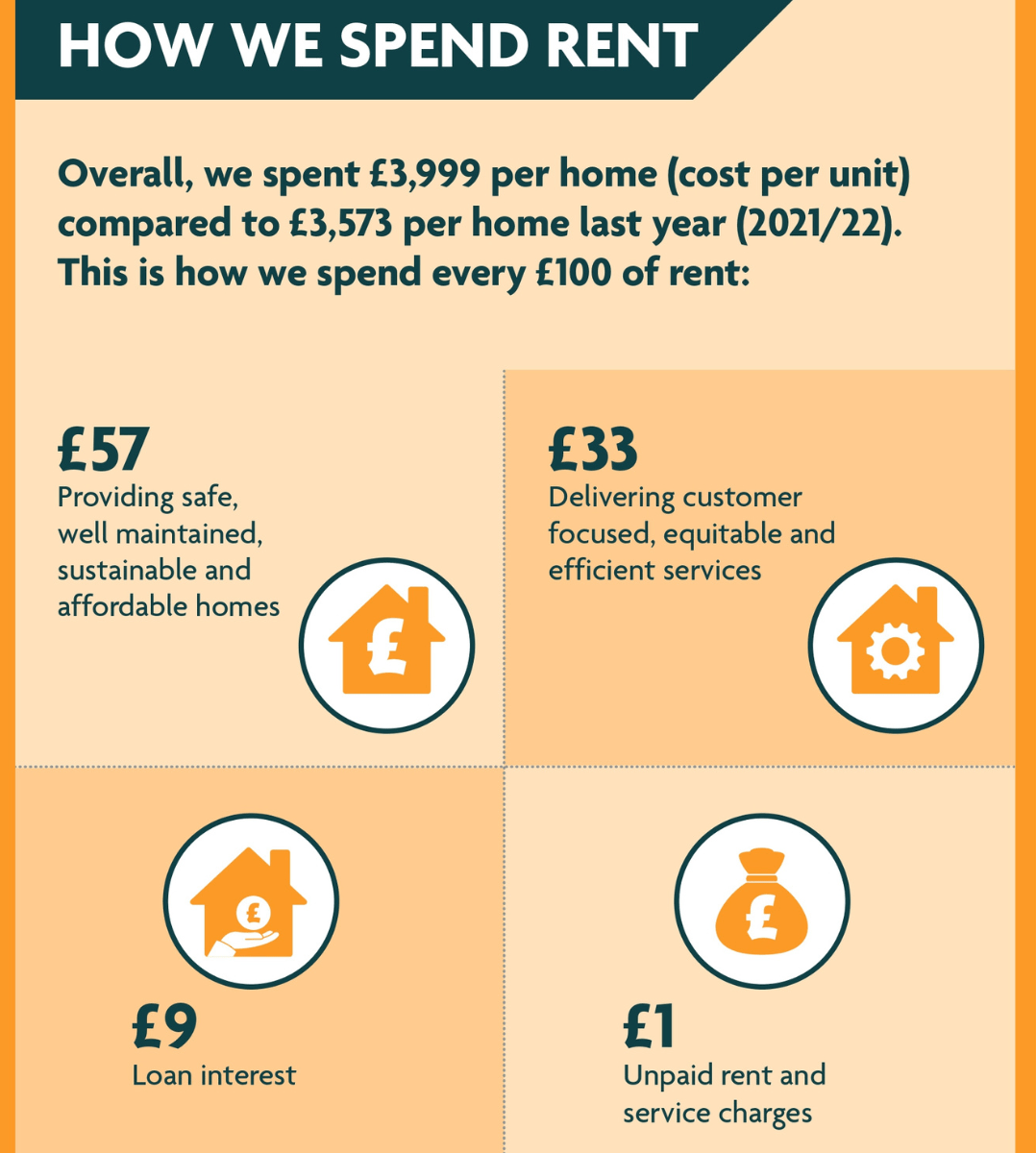
We’ve put together a breakdown of how we spend every £100 of rent we receive which you can see below:
You are our priority and we will do everything we can to support you, particularly through the cost of living crisis.
For instance, we can help with making sure you’re receiving all the financial support that you’re entitled to, including Universal Credit and Housing Benefit. We can also support with everything from contacting utility suppliers, giving advice on budgeting, affordable credit options or managing debt. We also have dedicated Money Advisors who can help with debt advice and solutions.
If you’re struggling with debt, ill health or other issues that affect your tenancy, then our skilled and experienced Tenancy Support and Sustainment Officers can offer valuable help, advice, and support to get you back on track.
There’s also lots of additional support that you can access via the ForHousing website – from accessing local food banks to how to contact Citizens Advice.
If you have concerns at all then please complete an online enquiry form or call us on 0300 123 5522.
The surplus deficit notified was calculated and informed on the basis of a typical 52 week rent year. However this year has 53 weeks so the (surplus)/deficit is being recovered or repaid over a 53 week period.